Cloud computing in manufacturing means running systems like ERP, analytics, monitoring, and backups on cloud platforms instead of purely on local servers. Production data becomes visible in real time. Scaling gets easier. Security improves. Most manufacturers get there gradually, through hybrid setups, not by replacing everything at once.
Key Takeaways
- Cloud in manufacturing means moving specific workloads (ERP, monitoring, analytics, backups) to cloud platforms so you get better visibility, resilience, and scale
- Real gains show up in cost savings, real-time visibility, predictive maintenance, and supply chain agility
- Security, integration, and change management are real challenges. They’re also solvable.
- Supply chain, quality control, predictive maintenance, and ERP are where cloud pays off fastest
- You don’t have to rip out existing infrastructure to start: most manufacturers migrate gradually through hybrid setups
- In a Nov. 29, 2023 press release, Gartner said that by 2028 cloud will be a necessary component for maintaining business competitiveness
- The question isn’t whether to move to the cloud anymore. It’s what order, and how fast.
The line went down at 2 a.m. on a Tuesday.
Six hours gone by the time anyone figured out why. The shift supervisor worked through the obvious stuff first: mechanical failure, operator error. Turned out it was a sensor. The data that would’ve told them that was sitting right there the whole time, logged and timestamped down to the second. It just lived in a system nobody could reach until the morning crew came in. By then, the damage was done.
That’s not an IT problem. It’s a visibility problem, and it’s exactly the kind of thing cloud computing in manufacturing is designed to prevent.
Most plant managers didn’t sign up to think about servers. You’re here to make things: efficiently, reliably, without bleeding margin on problems that could’ve been caught at 2:01 instead of 8:00. But the gap between what your equipment knows and what you can actually do something about has a real dollar figure attached to it. A compounding one.
In a Nov. 29, 2023 press release, Gartner said that by 2028 cloud will be a necessary component for maintaining business competitiveness. Not a nice-to-have. Necessary. And 2028 arrives faster than it sounds when you’re mid-cycle on capital planning. IT managed services providers like Scale Technology are already helping manufacturers work through that transition, before it becomes a catch-up problem.
What follows is a ground-level look at what cloud adoption actually means on the plant floor: where the gains show up, what it realistically costs in time and money, and how manufacturers are making the shift without blowing up systems they’ve relied on for years.
What Is Cloud Computing in Manufacturing?
Here’s the short version: cloud computing in manufacturing means your software runs on someone else’s servers instead of hardware your team owns and manages. That’s it. The nuance comes in how you use it.
Most manufacturers don’t flip a switch and move everything over. They migrate specific workloads, keep others on-premise, and connect the two deliberately. The workloads that tend to move first are the ones where flexibility and remote access matter most:
- ERP and production scheduling software: Accessible from any site, no VPN required
- Backup and disaster recovery: Offsite redundancy without buying more hardware
- Analytics and reporting: Aggregate data across lines or facilities without standing up a separate data warehouse
- Remote monitoring and equipment diagnostics: Real-time floor visibility from anywhere in the building or across multiple facilities
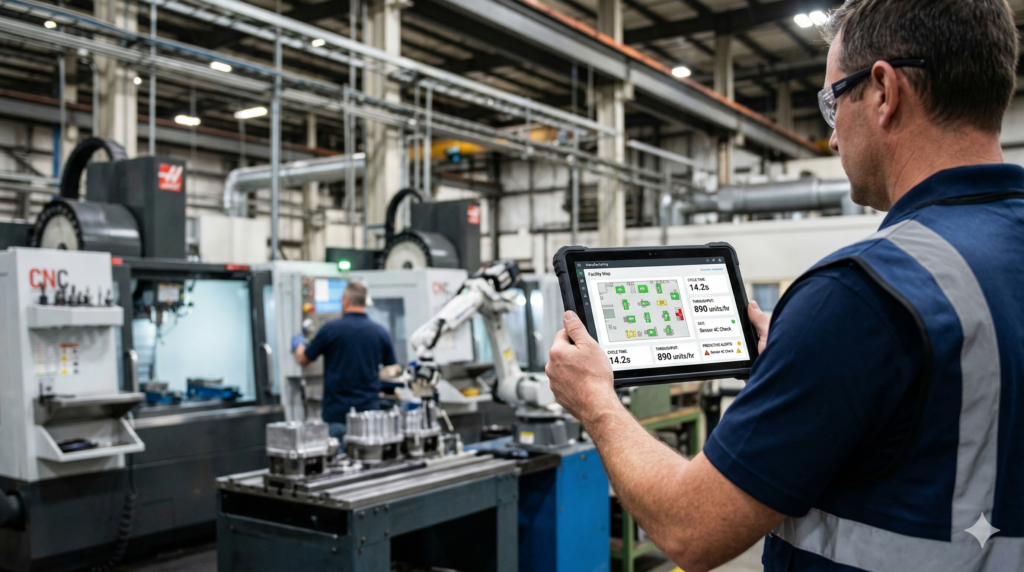
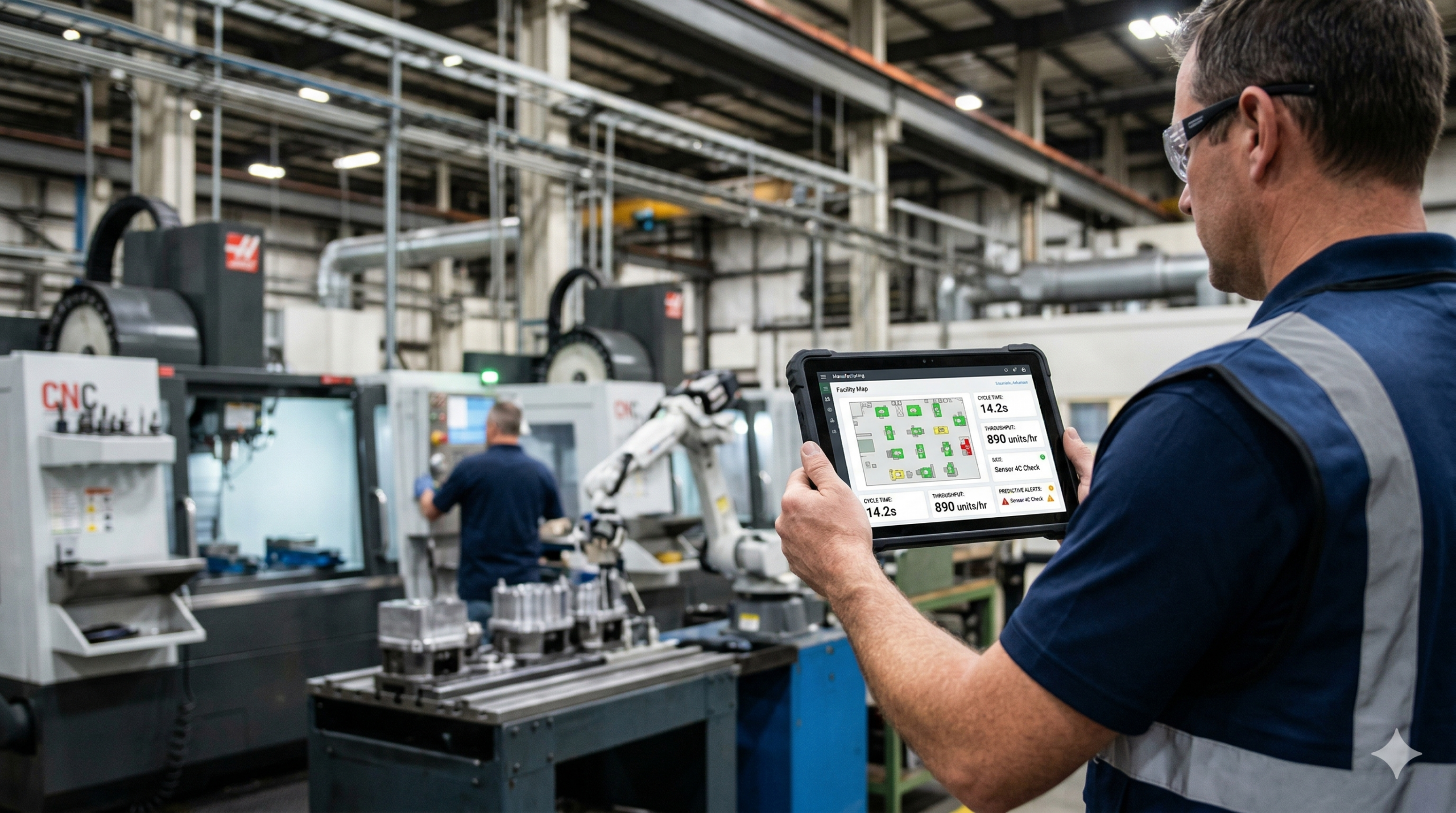
Think about what it looks like when a plant manager walks to the end of the production floor with a tablet and pulls up live equipment status: cycle times, temperatures, throughput. That data lives in the cloud now, not on a back-room server only IT can touch. That’s not a technology story. That’s an operations story.
Three Cloud Models That Matter for Manufacturers
| Model | Cost | Control | Typical Manufacturing Use Cases | Common First Workloads | Constraints |
|---|---|---|---|---|---|
| Public Cloud (AWS, Microsoft Azure, Google Cloud) | Lower upfront cost, pay-as-you-go | Less control over infrastructure | ERP, analytics, disaster recovery, remote monitoring | Backup and DR, reporting dashboards | Data residency requirements, latency for real-time OT data |
| Private Cloud | Higher upfront and ongoing cost | Full control over infrastructure and data | Regulated industries, sensitive IP, compliance-heavy environments | Core manufacturing execution, proprietary process data | Requires internal IT resources to manage |
| Hybrid Cloud | Moderate, varies by workload split | Balanced, you choose what goes where | Most manufacturers, especially multi-site operations | Start with non-critical workloads, expand deliberately | Requires thoughtful integration between environments |
Most manufacturers land on hybrid. Not because it’s the most exciting option, but because it’s the most honest one. You get to put each workload where it actually belongs.
Cloud also serves as a bridge between two worlds that have historically resisted each other: your operational technology (OT), the machines and sensors on the floor, and your IT systems, the software and data infrastructure running the business. That gap has caused headaches for a long time. Newer cloud platforms are getting genuinely better at closing it.
> A few terms worth knowing:
>
> * OT (Operational Technology): The hardware and software running your physical equipment and processes on the floor. Think PLCs, sensors, and the systems that keep machines moving.
>
> * IT (Information Technology): The systems and networks managing your business data, including ERP, reporting, communications, and everything that keeps the office side running.
>
> * PLC (Programmable Logic Controller): A ruggedized industrial computer that automates equipment on the shop floor. It’s been doing its job reliably for decades, which is partly why integrating it with modern software gets complicated.
>
> * IIoT (Industrial Internet of Things): The connected sensors and devices on industrial equipment that collect and transmit operational data in real time.
>
> * Edge computing: Processing data close to where it’s generated, on the factory floor, for instance, rather than routing everything to a central cloud server first. Useful when latency or connectivity is a concern.
>
> * Gateway/Middleware: The software or hardware that translates between OT systems and IT systems so they can share data without speaking different languages at each other indefinitely.
Worth pausing on this: IBM’s Institute for Business Value 2023 report found that only about half of IT executives say they’re actually capturing the benefits they expected from cloud, things like cost optimization, workload scaling, advanced analytics, and application modernization. Half. The other half are paying for capability they haven’t put to work yet.
That’s the real starting point. What operations teams are seeing on the ground is where things get interesting.
The Real Benefits Operations Leaders Are Seeing
Three things keep coming up when operations leaders talk about what cloud has actually done for their business: infrastructure costs came down, visibility across the floor got real, and they can respond to production changes without waiting weeks for IT.
These aren’t projections. Manufacturers are already seeing them in the numbers.
Finance tends to notice first. The cost structure changes in a way that’s hard to miss.
The old model meant buying servers you’d run at maybe 20% capacity. Capital locked into hardware that starts losing value before it’s installed. That’s the CapEx trap (capital expenditure: big upfront purchases for infrastructure you own and maintain forever). Cloud shifts that to OpEx (operating expenditure), usage-based payments tied to what you actually consume. You’re not buying for December’s peak in July. For manufacturers running on tight margins, that’s a fundamentally different conversation with the CFO.
The concrete wins operations leaders keep pointing to:
- See what’s happening on the floor, from anywhere. Production metrics, quality data, and supply chain status in real time, for anyone with the right access. Your shift supervisor in Ohio is looking at the same numbers you’re pulling up on your phone in Dallas, at the same moment.
- Scale capacity without buying hardware. Ramp up compute during peak runs, pull back during slow periods. You stop over-provisioning for December just because you need the capacity in November.
- Deploy new software in days, not months. No waiting on hardware orders, rack space, or a three-month implementation queue before anyone can log in.
- One shared data environment. Engineers, suppliers, and leadership working from the same source of truth. Fewer version-control headaches, fewer “which spreadsheet is current?” conversations.
The Volkswagen example is worth knowing. They rolled out a common cloud platform across 124 plants, 500 warehouses, and 1,500 suppliers in a program launched around 2020, targeting a 30% reduction in factory operating costs by 2025. On the procurement side, a McKinsey study on industrial cloud adoption found that companies using cloud-enabled procurement processes can see up to 60% improvement in procurement savings, though results vary by company maturity and implementation scope.
The broader industry is moving the same direction. According to Deloitte’s Manufacturing Industry Outlook, 80% of manufacturing executives plan to invest 20% or more of their improvement budgets in smart manufacturing initiatives, with cloud computing ranked as the primary driver of competitiveness over the next three years.
That’s a lot of organizations reaching the same conclusion at the same time. For manufacturers evaluating where to start, Scale Technology’s managed IT services help manufacturing teams navigate cloud adoption without going it alone.
Getting there isn’t automatic, though. Most manufacturers run into a predictable set of obstacles when they try to move, and knowing what those are before you start is what separates a clean transition from one that stalls halfway through.
What Challenges Do Manufacturers Face Moving to the Cloud?
Moving to the cloud isn’t painless, and anyone who tells you otherwise is selling something. Most manufacturers hit the same handful of friction points: cost concerns, legacy system entanglement, skeptical shop floor staff. Most of those are solvable with the right sequencing. The ones that aren’t get flagged early enough to plan around.
Is Cloud Computing Secure for Manufacturing Data?
Yes, and usually it’s more secure than what you’re running today. That’s not a sales pitch.
Think about the actual comparison you’re making. It’s not “our servers vs. the cloud.” It’s your internal IT budget vs. major cloud providers who spend billions annually on security research, certifications, and compliance frameworks. That’s a lopsided fight, and most manufacturers are losing it quietly.
The discomfort of moving production schedules, quality records, and supplier contracts off your own servers is real. But underfunded on-premises infrastructure isn’t safe just because it’s on-site.
Vendor selection still matters, though. Not all providers are built the same, and data backup solutions need to be in the strategy from day one, not patched in after something goes wrong.
How Do You Connect Old Factory Equipment to the Cloud?
You don’t need to rip out legacy equipment to get data off it.
A lot of machines on your floor have been running for fifteen or twenty years and were never designed to talk to anything. Pulling them out just to modernize your data stack isn’t realistic. Most manufacturers aren’t doing it.
Edge computing devices and IoT gateways solve this by collecting machine data locally and forwarding it securely to cloud systems without touching the machine controls. That CNC from 2004 stays exactly where it is. The data it generates gets captured and routed upstream without anyone laying a hand on the controls.
This is a solved problem. Manufacturers across the industry are already running it. The integration work takes real planning and a partner who’s done it before, but it’s not experimental. Scale Technology works with manufacturers through exactly these integration challenges, from legacy connectivity to full cloud deployment.
How Do You Get Shop Floor Staff on Board with Cloud Technology?
Involve them early, show them something genuinely useful, and don’t mandate without context.
Operators who’ve run the same systems for a decade will push back. Frankly, they should, because their concerns are usually worth hearing. Technology problems are often people problems in a different hat.
Phased rollouts help. So does hands-on training before go-live, not during it. Show someone a specific tool that makes their shift measurably easier and resistance drops fast. Try to mandate it without explanation and you’ll spend the next six months fighting for every inch.
What Happens If the Internet Goes Down in a Cloud-Connected Plant?
Your line keeps running. A well-designed hybrid setup keeps latency-sensitive, zero-tolerance control systems local. The cloud handles everything that can tolerate brief interruptions. A connectivity hiccup doesn’t stop production: local failover handles the gap while the connection restores.
This is a design question, not a limitation.
How Much Does Cloud Migration Cost for a Manufacturer?
Migration costs are real, and they’re not always what clients expect. What you’re paying for isn’t just infrastructure: it’s the gap between where your systems are and where they need to be.
Typical upfront costs include:
- Migration labor and project management
- Integration work connecting cloud systems to existing equipment and software
- Connectivity upgrades to support reliable data transfer
- Software licenses for cloud platforms and tools
- Staff training and change management
- Security tooling and compliance setup
What offsets those costs over time is harder to list cleanly, because it compounds differently for every operation. Hardware refresh cycles go away. Server maintenance shrinks. Downtime drops when monitoring improves and response gets faster. Reporting that used to take a week happens the same day. Most manufacturers see the upfront investment offset within two to three years, though the timeline depends heavily on which workloads they move first.
Start with one workload: ERP, quality management, or remote monitoring. Measure the outcome, then expand. Before committing to any cloud strategy, a structured IT risk assessment is worth doing so you’re not guessing at what needs to change first. IT risk management gives manufacturers a framework for evaluating technology risk before making large investments.
Cost is one side of that decision. The other is knowing which processes will actually deliver the most value when moved first, and that’s where sequencing gets interesting.
Which Manufacturing Processes Benefit Most from Cloud
Supply chain, ERP, predictive maintenance, and remote monitoring tend to show the clearest returns. That’s not a coincidence. Those are the areas where data being accessible and current actually changes what you do next, not just what you report on.
Not every part of your operation will feel it right away. Some processes are just a better fit for cloud than others, and knowing that ahead of time lets you sequence the move intelligently. The table below gives you a working frame before we get into the specifics.
Where to Start: Cloud Migration at a Glance
| Process | Complexity | Risk | Time to Value | Typical Prerequisites |
|---|---|---|---|---|
| Backup and Disaster Recovery | Low | Low | Weeks | Internet connectivity, basic IT support |
| Remote Monitoring | Low | Low | 1-3 months | Connected equipment or sensors, dashboard tooling |
| Supply Chain and Procurement | Medium | Medium | 3-6 months | Supplier data integration, ERP readiness |
| ERP and Production Scheduling | High | Medium-High | 6-12 months | Process documentation, change management plan |
| Quality Control | Medium | Medium | 3-6 months | Inspection data sources, camera or sensor infrastructure |
| Predictive Maintenance | High | Low-Medium | 6-12 months | Sensor-equipped equipment, historical maintenance data |
- Supply chain and procurement. Most stockouts aren’t actually supply problems. They’re visibility problems. A supplier pushes back a lead time by two weeks, and if your systems are disconnected, you find out when the line stops. Cloud ERP ties together inventory, purchase orders, and supplier data so that two-week slip shows up the day it happens. That’s the difference between adjusting and scrambling.
- ERP and production scheduling. On-premises ERP carries a lot of overhead: servers to maintain, IT staff to keep them alive, upgrade cycles that nobody wants to touch because something critical is running on that system. Cloud changes that. Your team accesses it from anywhere, updates run in the background, and you’re not carrying the hardware burden. Plant managers can pull production data from a phone. Finance can run reports from home. That kind of access matters more than most people admit until they don’t have it.
- Predictive maintenance. Sensors on your equipment generate a constant stream of data: vibration, temperature, cycle counts, pressure. Feed that into cloud analytics and patterns start to emerge before they become failures. You can catch a bearing running hot or a motor drawing more current than usual weeks before it takes down a line. For a closer look at how this works in practice, see predictive maintenance strategies.
- Quality control. AI and machine learning models running in the cloud can process inspection data, camera feeds, sensor readings, faster and more consistently than manual floor review. When defects surface earlier in the process, they don’t have time to become expensive ones. That’s the part manufacturers often underestimate until they run the numbers on scrap and rework.
- Remote monitoring. You don’t have to be standing on the floor to know what’s happening. Cloud dashboards pull real-time production data and surface it wherever you are. For multi-site operations especially, that visibility changes how you manage and who actually needs to be physically present to stay informed.
What connects all of these is simple: cloud pulls your operational data out of siloed systems and puts it somewhere you can work with it. Once you’ve identified which processes carry the most friction or the most exposure, the starting point usually becomes obvious. The harder question is how to get there without breaking what’s already running.
Frequently Asked Questions
How long does cloud migration take for a manufacturing company?
Backup and disaster recovery can be live in weeks. A full ERP migration, with data cleanup, staff training, and integrations, usually runs six to twelve months. Most teams start with the simpler pieces for a reason: you build internal confidence and capability before you tackle the heavier lifts.
Do I need to replace my existing equipment to use cloud computing?
Probably not. Most cloud platforms connect to equipment you already have through sensors and edge devices that collect data from your machines on the floor. The cloud handles storage, analysis, and access. You might need to add sensors to older equipment, but a full hardware replacement isn’t usually required to get started, and it’s definitely not where most manufacturers begin.
What is the difference between OT and IT in manufacturing?
IT covers business data: ERP, email, finance software. OT covers physical equipment: PLCs, SCADA systems, industrial control networks. Historically those two worlds didn’t talk to each other much. Cloud adoption in manufacturing is largely about bridging that gap, getting production data out of OT systems and into platforms where plant managers, IT teams, and executives can actually analyze it and act on it. That connection is where a lot of the real operational value lives.
Can small and mid-sized manufacturers afford cloud computing?
We hear this one a lot, and the honest answer is that cloud usually changes the math in your favor. You’re trading a capital expense, servers, dedicated IT staff, upgrade cycles that slip every budget season, for a subscription that scales with your usage. Start with what you need now. Add capacity as the business grows.
How do I choose the right cloud provider for my manufacturing business?
Start with integrations. What ERP are you running? What production or quality systems are already in place? The provider that connects most cleanly to your existing stack is usually the right starting point. Beyond that, look at their track record with industrial clients, their compliance and data residency options, and how much implementation support they actually provide. Microsoft Azure, AWS, and Google Cloud all serve manufacturing at scale. Many manufacturers also work with a systems integrator who specializes in their industry vertical rather than going direct to a hyperscaler, and that’s often worth the conversation early.
What happens to my data if my cloud provider goes down?
Your data gets copied across multiple locations, not parked in one server room hoping nothing catches fire. When a data center goes down, traffic reroutes automatically. That’s why major outages from serious providers are uncommon, not lucky. You’ll also see uptime guarantees and recovery time objectives written into enterprise agreements. Good. Hold them to it. But before you sign, push them specifically on regional failures. How they answer that question tells you a lot.
Getting Started Without Ripping Everything Out
Too many manufacturers treat this like a construction project with a fixed end date. It isn’t. It’s a phased transition, and sequencing matters far more than speed. Here’s how to approach it without creating a crisis.
- Audit what you have. Map every system before anything moves. On-premises, cloud-capable, genuinely mission-critical versus “we’ve just always run it that way.” You’d be surprised how often that last category is bigger than anyone expected. You can’t build a real migration plan from a fuzzy starting point.
- Start with workloads that won’t stop the floor. Backups, email, file storage, collaboration tools, business analytics. None of those touch production. Moving them first builds your team’s experience and flushes out connectivity or security issues somewhere it’s safe to have a problem. You don’t start with the PLC running your assembly line. Ever.
- Match your cloud model to your actual situation. Public cloud is cost-effective and scales easily. Private cloud gives you control, which matters when compliance or sensitive data is involved. Hybrid is where most manufacturers land, because different workloads have different requirements. The right answer depends on your regulatory environment, your network infrastructure, and how much latency your operations can actually tolerate. Those aren’t hypothetical questions when a line is running.
- Find an IT partner who’s been on a shop floor. Designing architecture isn’t the hard part. You need someone who understands OT/IT convergence, knows industrial protocols, and has already worked through what happens when connectivity drops mid-shift. A managed IT services partner with real manufacturing experience handles the infrastructure so your team stays focused on operations. If you’re not sure what that looks like day-to-day, what managed IT services include lays it out plainly.
- Take the people side seriously. This is where transitions actually fall apart. Training gets pushed to the last minute, nobody explains the why, and you end up with a capable system that the floor crew doesn’t trust. Get people ready before go-live. Designate internal champions. Roll it out one facility or department at a time so the whole operation isn’t absorbing the shock simultaneously.
Ready to Build Your Cloud Roadmap?
Figured out which workloads to migrate yet? If not, that’s exactly where we start. Most manufacturers we talk to know they need to move but aren’t sure where the risk actually lives in their stack. Schedule a free consultation with Scale Technology and we’ll map it out with you. Or just call us at (501) 588-3199.